
Engineered oak flooring and three-layer parquet are easy to confuse, because both are types of natural engineered wood floor. They differ, however, in the construction of the core, in the thickness of the top layer, in the installation, and in how many times they can be sanded. It is precisely this difference that has a significant effect on the stability and durability of your floor.
What is three-layer parquet
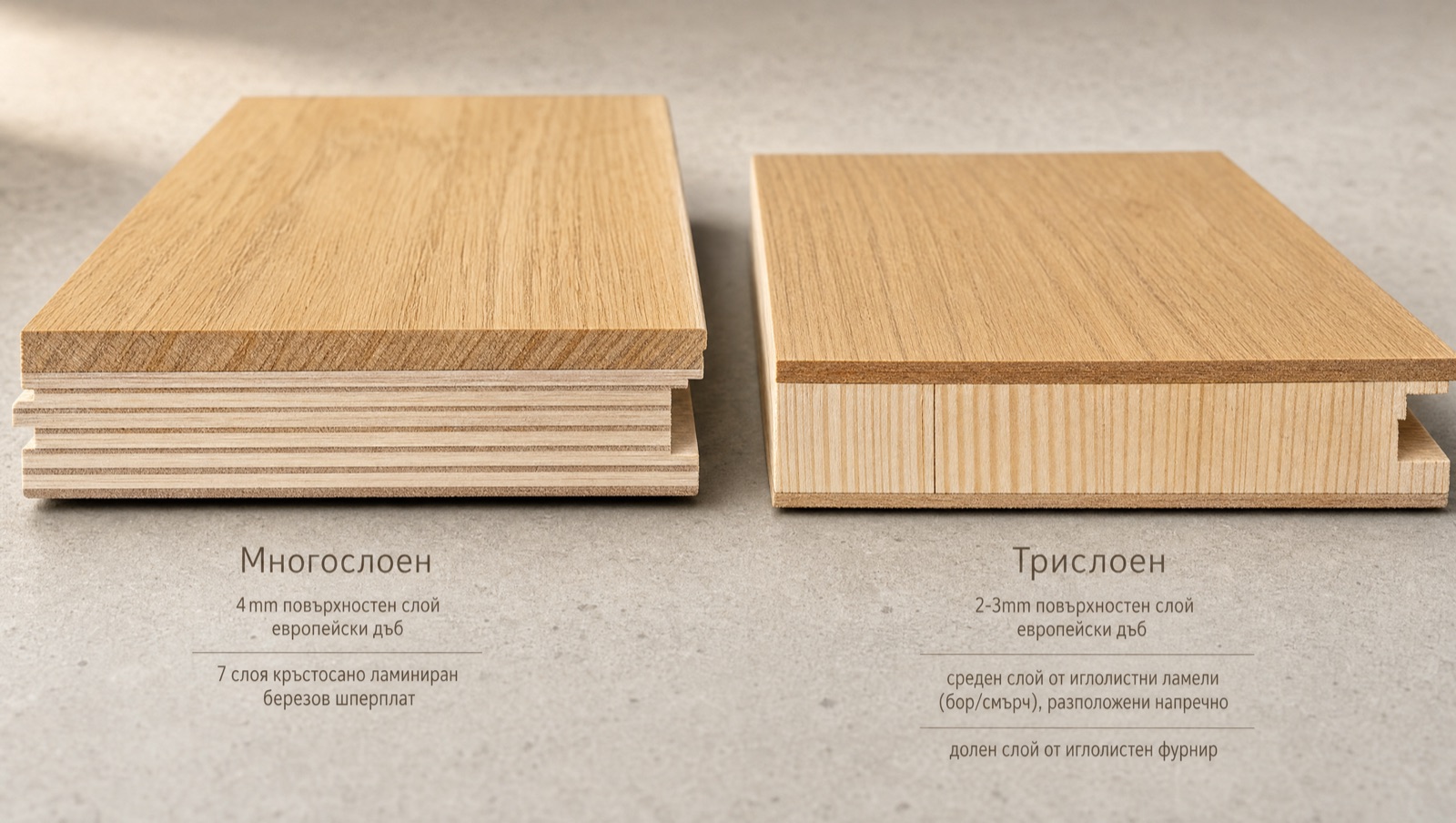
Three-layer parquet is a mass-produced industrial construction, which literally means three layers of wood bonded crosswise, one on top of the other.
- Top (wear) layer — hardwood, most often oak. Thickness usually 2–3 mm, and 0.6–1.5 mm (veneer) in some more affordable ranges.
- Middle layer — softwood lamellas (pine, spruce) laid crosswise to the top layer. This layer absorbs the expansion when humidity changes.
- Bottom (balancing) layer — a thin softwood veneer laid in the same direction as the top layer. It balances the construction.
The thickness is standard — usually 14 mm. The joint between the elements is tongue-and-groove in the professional ranges and click in the mass market. Classic three-layer parquet in Europe is produced mainly in Sweden, Germany, Austria and Poland.
What is engineered oak flooring
Engineered oak flooring (also called plank flooring) follows the same idea — hardwood on top, a stabilizing core underneath — but the construction is considerably more stable:
- Top layer — a full lamella of hardwood (most often European oak, and sometimes walnut, ash or iroko). Thickness 3–4 mm. At the Artistico factory we make all our engineered floors with a 4 mm top layer — the maximum for standard production.
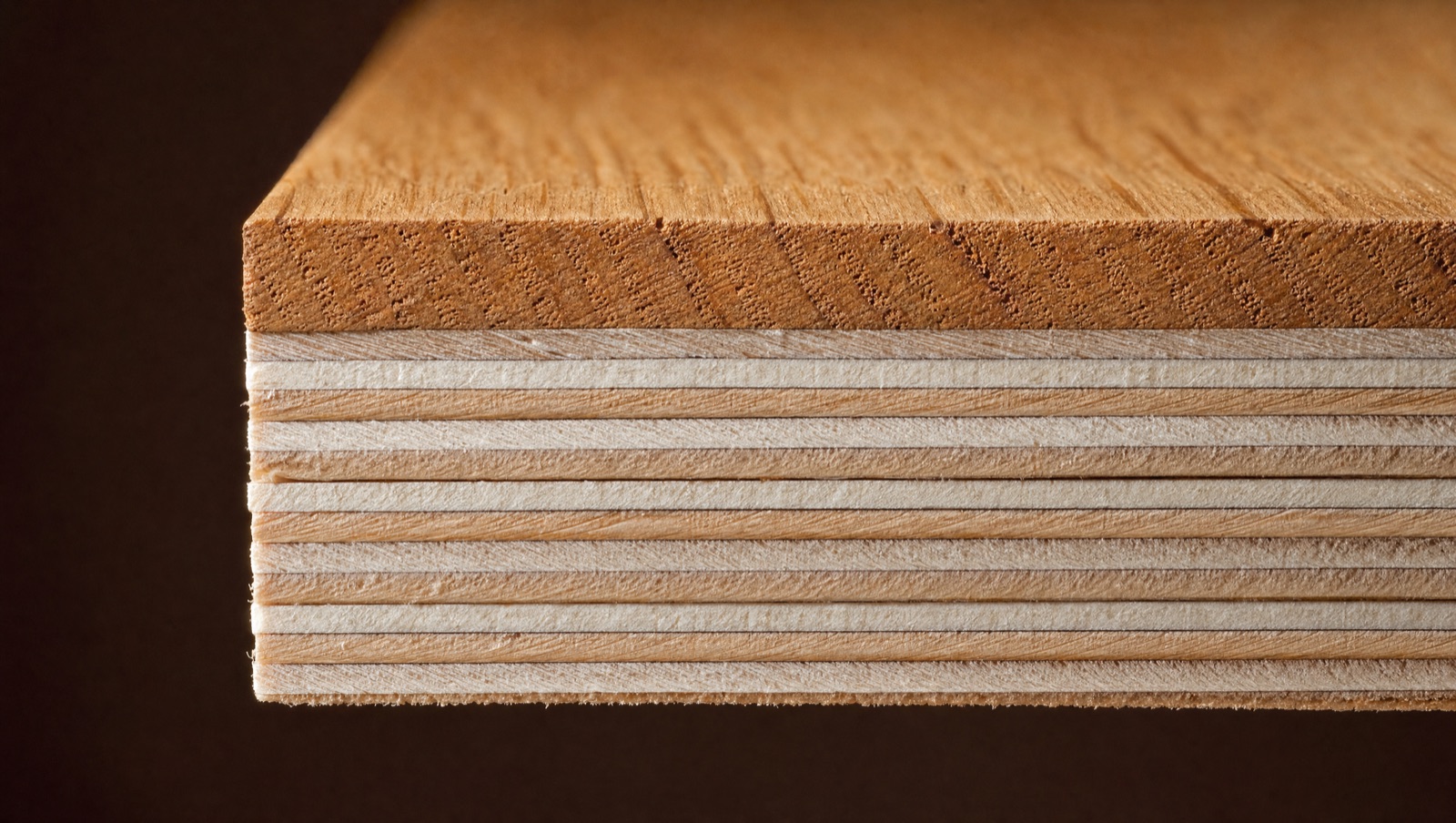
- Core — birch plywood with 5 to 9 cross-bonded layers. This is not a solid board but an engineered material designed not to move when humidity changes.
Cross-bonding is the technical basis of the difference. Each layer is laid at 90° to the one next to it — so the shrinkage and expansion of one is canceled out by the other. The result is a construction that in practice does not react to seasonal changes. It is more stable, it handles underfloor heating and wide rooms better, and with a 4 mm top layer it withstands 3–4 sandings — effectively decades of use without replacement.
At Artistico we make only engineered oak flooring — 4 mm European oak on birch plywood. Our standard thicknesses are 16 mm (12 mm core + 4 mm oak top layer) or 19 mm (15 mm core + 4 mm oak top layer). Width 90–220 mm as standard, up to 240 mm to order. The joint is always tongue-and-groove — never click.
The differences row by row
The table compares the most common three-layer construction with the engineered oak flooring produced by Artistico.
| Parameter | Three-layer parquet | Engineered oak flooring |
|---|---|---|
| Number of layers | 3 | 5–9 |
| Top layer thickness | 2–3 mm (most often 2 mm) | 3–4 mm (Artistico: 4 mm) |
| Core | Softwood lamellas | Birch plywood, cross-bonded |
| Moisture stability | Good | Very good — it barely moves |
| Underfloor heating | Suitable, with limitations | Suitable — especially the 16 mm version |
| Sanding and refinishing | 1–2 times | 3–4 times (with a 4 mm top layer) |
| Expected lifespan | 20–30 years | 40–60 years or more |
| Standard thickness | 14 mm | 16 or 19 mm |
| Installation | Click (in most cases) or glued down | Always glued down — 2K polyurethane |
| Origin | Mass-produced — Europe | At Artistico — our own production, Trud (Plovdiv) |
What are the main practical differences
1. How many times the floor can be sanded
This is the difference customers notice after about fifteen years. A full sanding takes off part of the top wood layer to remove the scratches and restore the surface for a new coat of lacquer or oil, and the amount depends on the condition and flatness of the floor.
Three-layer parquet, with a top layer of around 2 mm, usually leaves less room for a full sanding. Artistico's engineered oak flooring has a 4 mm layer of natural oak, which allows up to 3–4 sandings over the years. The exact number depends on the condition of the floor and the way each sanding is carried out. That way a 30-year-old floor can be refreshed and passed on to the next generation.
2. Behavior over underfloor heating
Underfloor heating places higher demands on natural wood flooring. The repeated cycles of heating and cooling affect the wood, so construction, thickness and installation method are all essential.
The cross-bonded birch plywood core limits the natural expansion and contraction of the wood. This gives better dimensional stability than the usual softwood core of three-layer parquet, especially with wider planks and in spacious rooms.
For parquet over underfloor heating Artistico recommends 16 mm engineered oak. The smaller thickness lets heat pass through more efficiently than a 19 mm construction. A reliable result also requires a dry and well-prepared screed, full glue-down installation, a gradual start-up of the system, a controlled floor surface temperature and relative air humidity between 40 and 60%. Meeting these conditions limits the risk of deformation, opening gaps and cracking over the years.
3. How wide the planks can be
In spacious rooms, wider planks often create a calmer, more unified look, while narrow ones emphasize the individual lines of the floor more strongly. The right width is chosen according to the size, proportions and style of the room, and in large spaces planks of 160 mm and wider are often preferred.
With mass-produced three-layer parquet, the choice is usually limited to predefined sizes, which in many collections reach around 180–190 mm. The engineered construction on a cross-bonded birch plywood core allows the production of wider planks with better dimensional stability than solid wood.
Artistico offers engineered oak flooring up to 220 mm wide in standard production, up to 240 mm depending on the specific project and up to 300 mm as a special order. The final size is determined by the room, the chosen wood species and the installation conditions.
4. Installation — click or glued down
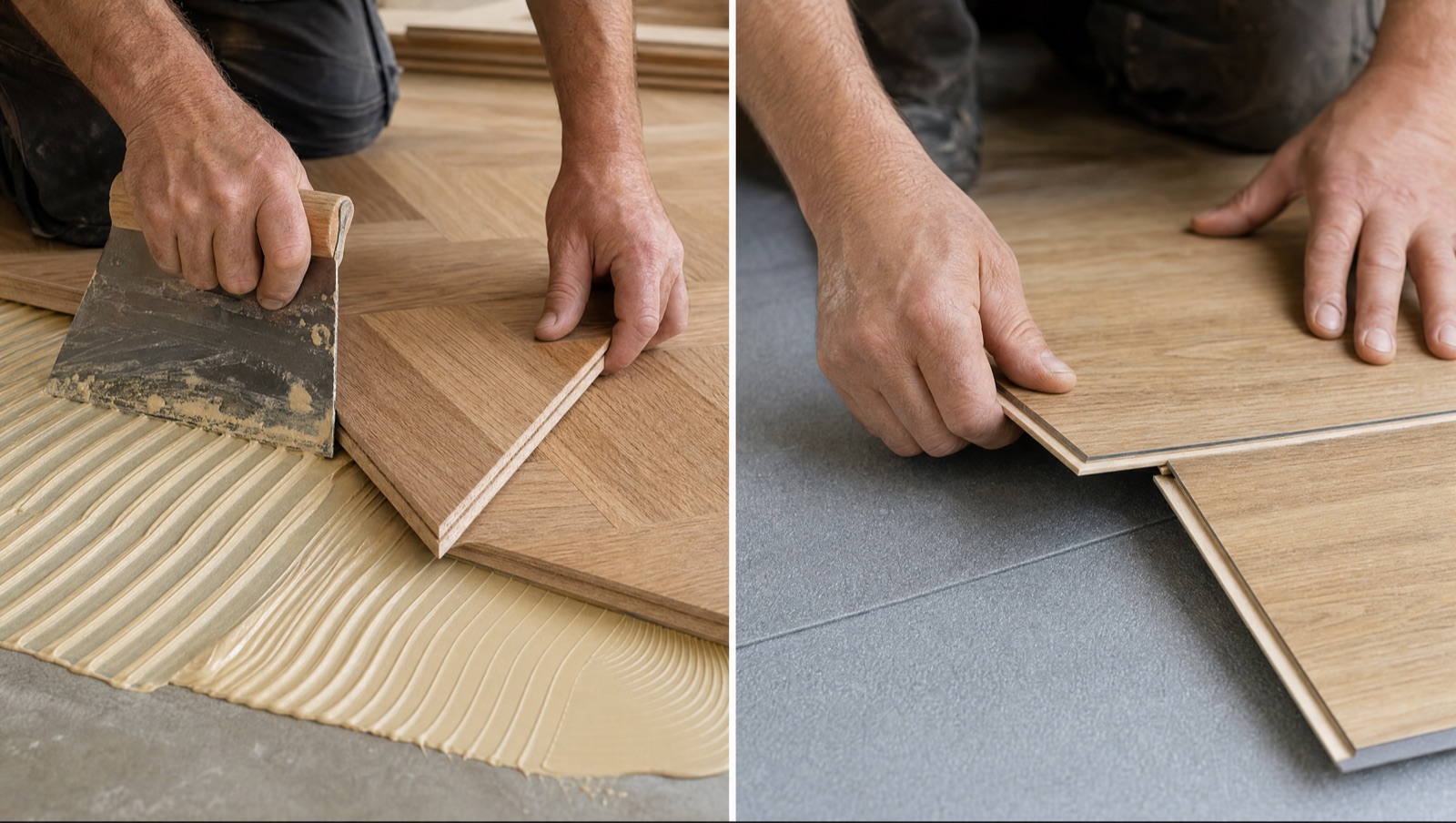
Three-layer parquet is often offered with a click system and can be laid floating over an underlay, without being fully glued to the screed. This method allows faster and more affordable installation. Because the floor is not bonded directly to the subfloor, however, walking on it can feel more hollow. The final result depends on how level the screed is, the quality of the underlay, expansion gaps left in the right places and professional workmanship.
Artistico's engineered oak flooring is made with a classic tongue and groove joint and is fully glued down onto a well-prepared subfloor. This creates a denser and more stable bond with the screed, limits movement between the individual planks and improves heat transfer with underfloor heating.
The installation uses a professional adhesive system, chosen according to the type of subfloor and the conditions of the specific project. Where necessary, this can be a two-component polyurethane adhesive. Correct preparation, the right adhesive and quality installation directly affect the stability and long service life of the wood floor.
Click systems are found on natural wood flooring as well, but Artistico chooses tongue and groove with glued-down installation for the denser feel, better stability and the ability to produce wide planks and custom floor compositions.
5. Price versus long-term value
Three-layer parquet usually has a lower initial price and at first glance can look like the more practical choice. The exact difference, however, depends on the manufacturer, the construction, the thickness of the top layer and the installation method.
In the long term, engineered oak flooring can offer better overall value, because it allows more options for renewal. A full replacement adds the cost of taking up and hauling away the old floor, preparing the subfloor, new material and installing again. Engineered oak flooring with a sufficiently thick top layer can be professionally sanded and refinished in place, without being taken up and without disturbing the screed.
The more stable option is not always the better one
We are not writing this article to convince you that engineered oak flooring is the only right solution.
There are projects where good-quality three-layer parquet fully meets the need:
- A rental property or a temporary home — when you want natural wood at a more affordable initial price.
- Smaller rooms with a standard solution — if very wide planks, special sizes or a special finish are not needed, three-layer parquet can be entirely sufficient.
- A limited budget but a desire for natural wood flooring — a good three-layer oak parquet is a sensible choice when you are set on real wood but do not have the budget for engineered oak flooring.
For spacious rooms, wide planks, non-standard sizes and interiors created with decades in mind, we would steer the choice toward engineered oak flooring. The same applies when you are looking for a floor over underfloor heating with glued-down installation and more scope for sanding in the future. This does not mean that three-layer parquet is unsuitable in all such cases — a quality model approved by its manufacturer can also work well. The difference is that Artistico's engineered construction offers greater freedom in sizes, finish and the overall execution of the project.
A construction built on more than 25 years of experience
For more than 25 years we have been making and installing natural wood flooring at our base in the village of Trud near Plovdiv. Over the years we have worked with solid oak, three-layer parquet and various engineered constructions. That experience helped us define the characteristics we look for in our own engineered floors:
- 4 mm top layer of natural European oak;
- 12 or 15 mm core of cross-bonded birch plywood;
- 16 or 19 mm total thickness, depending on the project and the conditions in the room;
- tongue-and-groove joint, designed for a full glue-down to the prepared subfloor;
- factory lacquer or oil, applied on our own UV line with Loba systems.
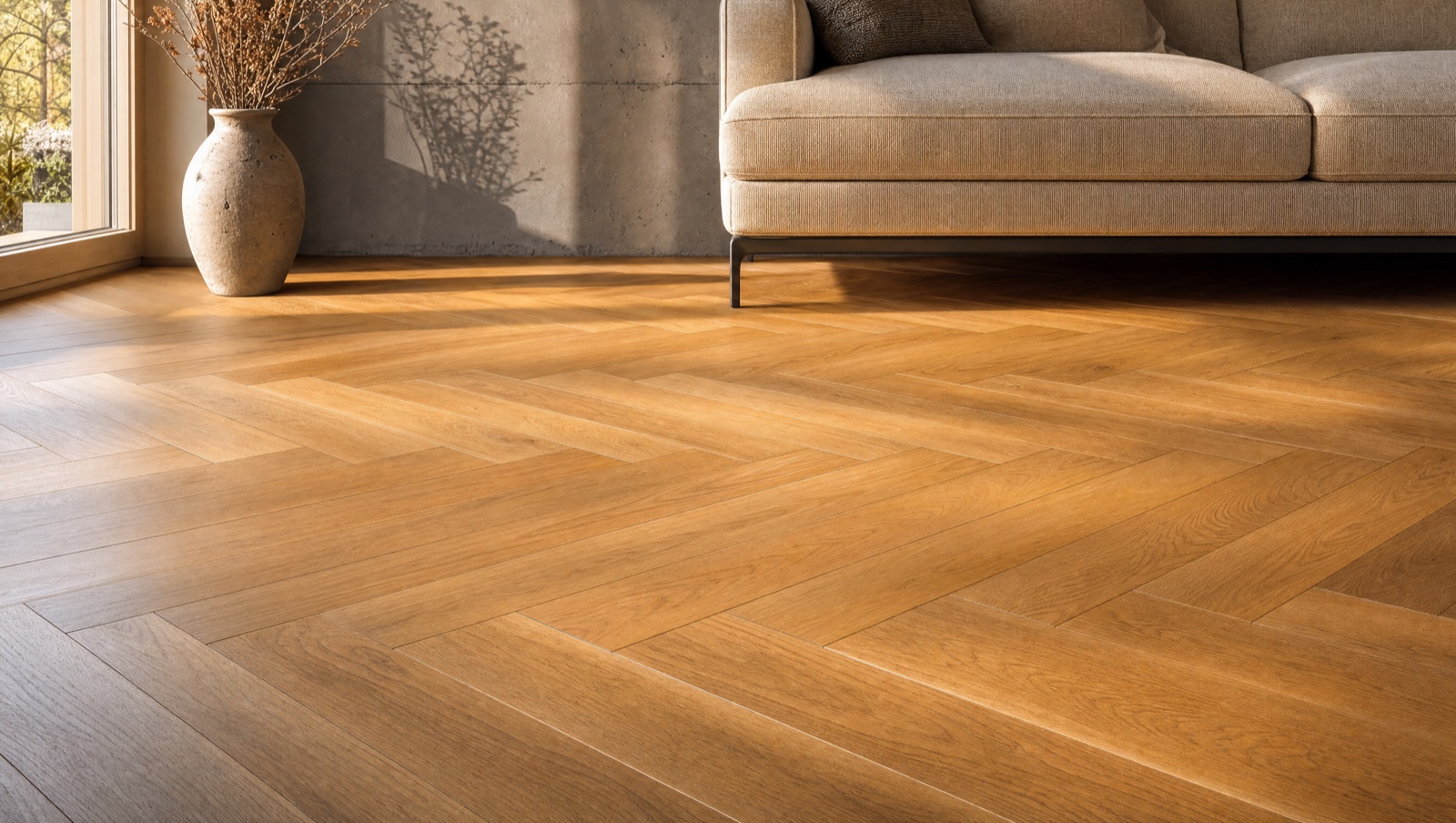
We use this principle of engineered construction for the long planks, the herringbone and chevron parquet and the rest of our engineered floors. The rosettes, panels and friezes for art parquet are made in the matching thickness, so that they can be installed flush with the main flooring.
Production, delivery, installation and the final finishing are planned as one process and carried out by a specialist team. That gives you a single point of contact and a single party responsible for the end result, the warranty and the future maintenance of your wooden floor.
Engineered and three-layer parquet — frequently asked questions
What is the difference between engineered and three-layer parquet?
The main difference is in the core and in the thickness of the top layer. Three-layer parquet has three layers — a 2–3 mm oak top layer, a softwood middle core and a thin balancing backing. Engineered oak flooring has 5–9 layers of cross-bonded birch plywood as its core and a thicker top layer — 3–4 mm. The engineered construction is more stable, better suited to underfloor heating and wide planks, and it can be sanded 3–4 times compared with 1–2 times for the three-layer one.
Which parquet is better for underfloor heating?
Engineered oak flooring at 16 mm thickness with a 4 mm oak top layer over birch plywood — that is the optimal combination. The thinner version transfers heat more efficiently than the 19 mm one, and the cross-bonded core barely moves with changes in temperature. Three-layer parquet is also compatible with underfloor heating, but its softwood core moves more, especially with planks over 160 mm wide.
How many times can engineered oak flooring be sanded?
With a 4 mm top layer — 3 to 4 full sandings. Each sanding takes about 0.5–0.8 mm off the surface, to remove the scratches and restore the finish. Three-layer parquet with a 2 mm top layer usually takes one, at most two sandings, before it reaches the softwood middle core.
Why does Artistico make only engineered and not three-layer parquet?
We have been making floors in Trud, Plovdiv for 25 years. Step by step we narrowed our production down to one construction we can stand behind for decades — engineered flooring with a 4 mm European oak top layer over cross-bonded birch plywood. This combination works reliably with underfloor heating, in large rooms and with wide planks, and it withstands repeated sanding. The three-layer construction has its place on the market, but it does not meet the standard we hold our own floors to.
What is the production time for engineered oak flooring?
For most models — 3 to 6 weeks. Standard colors and widths are at the lower end of that range; more complex colors or non-standard widths over 280 mm are at the upper end. By comparison, imported high-end ranges from Italy or Canada have a typical lead time of 2–4 months.
How much does engineered oak flooring cost?
At Artistico, prices for engineered oak start at around 132 BGN/m² for unfinished material and reach around 250 BGN/m² for walnut or special widths. Standard color options are in the 150–160 BGN/m² range. The prices are published in our online shop — we do not work with hidden prices or quotes given only on request.
Can engineered oak flooring be installed with a click system?
Engineered oak flooring from Artistico is always installed glued down with a two-component polyurethane adhesive. A click installation is not recommended for wooden parquet — the floor “floats” on the screed and, as the seasons change, it knocks, creaks and opens up at the joints. The joint between the planks is always tongue and groove. Click technology is suitable for SPC vinyl and laminate — different types of flooring.
How long does engineered oak flooring last?
Engineered oak flooring with a 4 mm top layer, glued down with PU adhesive and maintained with periodic sanding and renewal of the finish, lasts 40–60 years and more. This is not a marketing figure — we are talking about floors we installed 20–25 years ago that are still in good working order, on their first or second sanding cycle.
Not sure which one is right for your project? We are ready to come out and take the measurements at a time that works for you — the visit is free and with no obligation. We bring real samples of the combination you have chosen — wood, finish, width — so you can see how it looks in natural light before you decide.