
Herringbone and chevron are often confused. Both lay the boards in a rhythmic pattern, and both bring movement and character to a floor. The difference is at the end of each board — and it changes how the whole room feels. Here is how to tell them apart and how to choose.
The difference at a glance: the end of the board
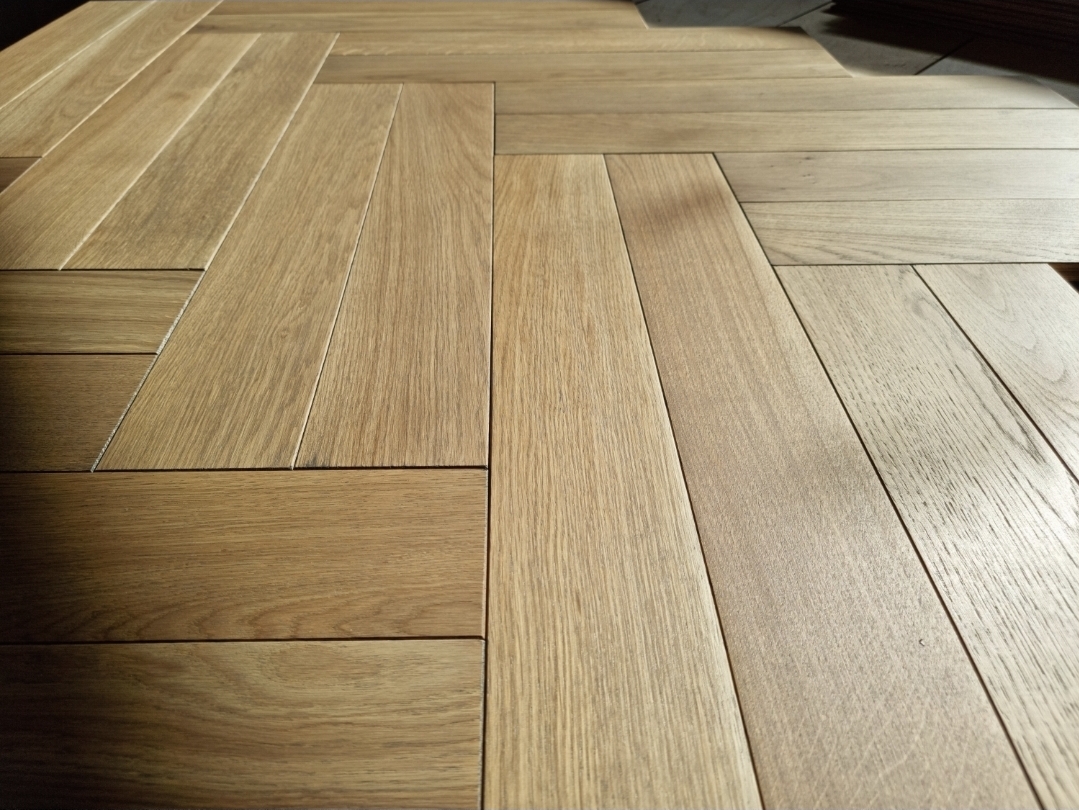
In classic herringbone the lamellas are rectangular. They are laid at a right angle (90°), with the short end of each board meeting the long side of the next. The boards are staggered and form the familiar zigzag — dense, rhythmic and easy to recognise.
In chevron, also called Hungarian point, the ends of the lamellas are cut at an angle — 45° or 60° — and the boards meet tip to tip. The result is a straight, continuous line and a clear arrow (V) that repeats along the length of the room.
The easiest way to tell them apart is to look for the line where the boards meet. If it is straight and unbroken, it is chevron. If the board ends step past each other, it is herringbone.
How each pattern feels in a room
Herringbone adds movement and depth. It is classic and rhythmic, and it works in traditional and contemporary interiors alike.
Chevron is cleaner, symmetrical and more architectural. The V-shaped lines lead the eye and visually lengthen the room along the chosen axis. That is why it works especially well in modern interiors, open-plan living rooms and spaces with a clear direction.
If you want an even bolder rhythm, there is a third option — double herringbone, where the lamellas alternate in pairs in each direction. And if you want a calmer floor where the oak grain leads, compare the patterns with the long plank as well. You will find a comparison of the three on the page Herringbone and chevron parquet.
45° or 60°: the chevron angle
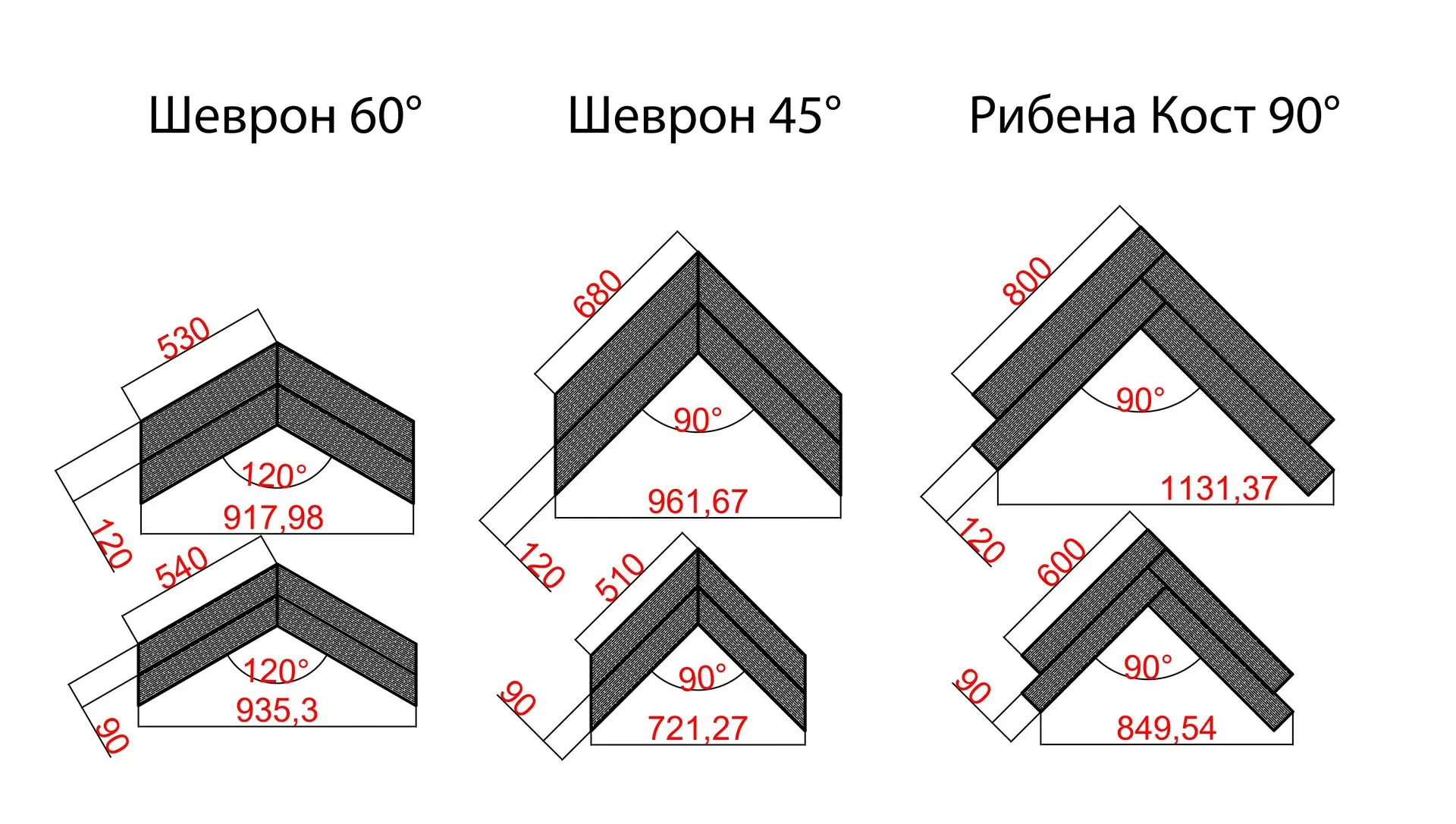
Chevron can be made in two angles, and the difference is visible at once:
- Chevron 45° — a sharper, more dynamic V-line.
- Chevron 60° — a wider, calmer V-line.
Classic herringbone is always laid at 90°. The chevron angle depends on the proportions of the room and on how expressive you want the floor to be.
Lamella size and room size
The size of the lamellas sets the scale of the pattern. A width of 90 mm gives a finer, more dynamic geometry; 120 mm gives a bolder, more formal rhythm. We offer lengths from 510 to 800 mm and thicknesses of 16 or 19 mm, and special sizes to order when needed.
As a guide by floor area:
- up to 12 m² — finer classic herringbone with 90 mm lamellas; chevron only after assessing the shape of the room and the visible floor area;
- 12–25 m² — herringbone in 90 or 120 mm, and in well-proportioned rooms also chevron 45° or 60°;
- 25–60 m² — chevron 45° or 60°, double herringbone or herringbone with 120 mm lamellas;
- over 60 m² — chevron, double herringbone or a bespoke composition.
Floor area is only a starting point. The final choice also depends on the shape of the room, the light, the furniture and the laying direction. For more on choosing room by room, see How to choose a wood floor room by room.
Solid or engineered construction
Both herringbone and chevron can be made as solid or as engineered parquet. The solid version is natural wood throughout and suits classic interiors and restorations. The engineered construction has a 4 mm top layer of European oak on a birch plywood core and is more stable when temperature and humidity change.
If the room has underfloor heating, we recommend engineered herringbone or chevron with glued installation. We explain why in detail in Wood flooring over underfloor heating — what you need to know.
Why installation decides the result
In herringbone and chevron every lamella is part of a larger geometry. Even a small deviation in the starting axis repeats in every following row and can show across the whole room. That is why our installation goes through several fixed steps:
- Checking the subfloor — flatness, strength and residual moisture of the screed.
- Planning the direction and the centre axis against the shape of the room, the light and the entrances.
- Sorting the lamellas by tone and grain; for chevron, the left and right pieces are distributed.
- Glued installation, with every row checked against the set axis.
- A final check of the lines, joints and transitions.
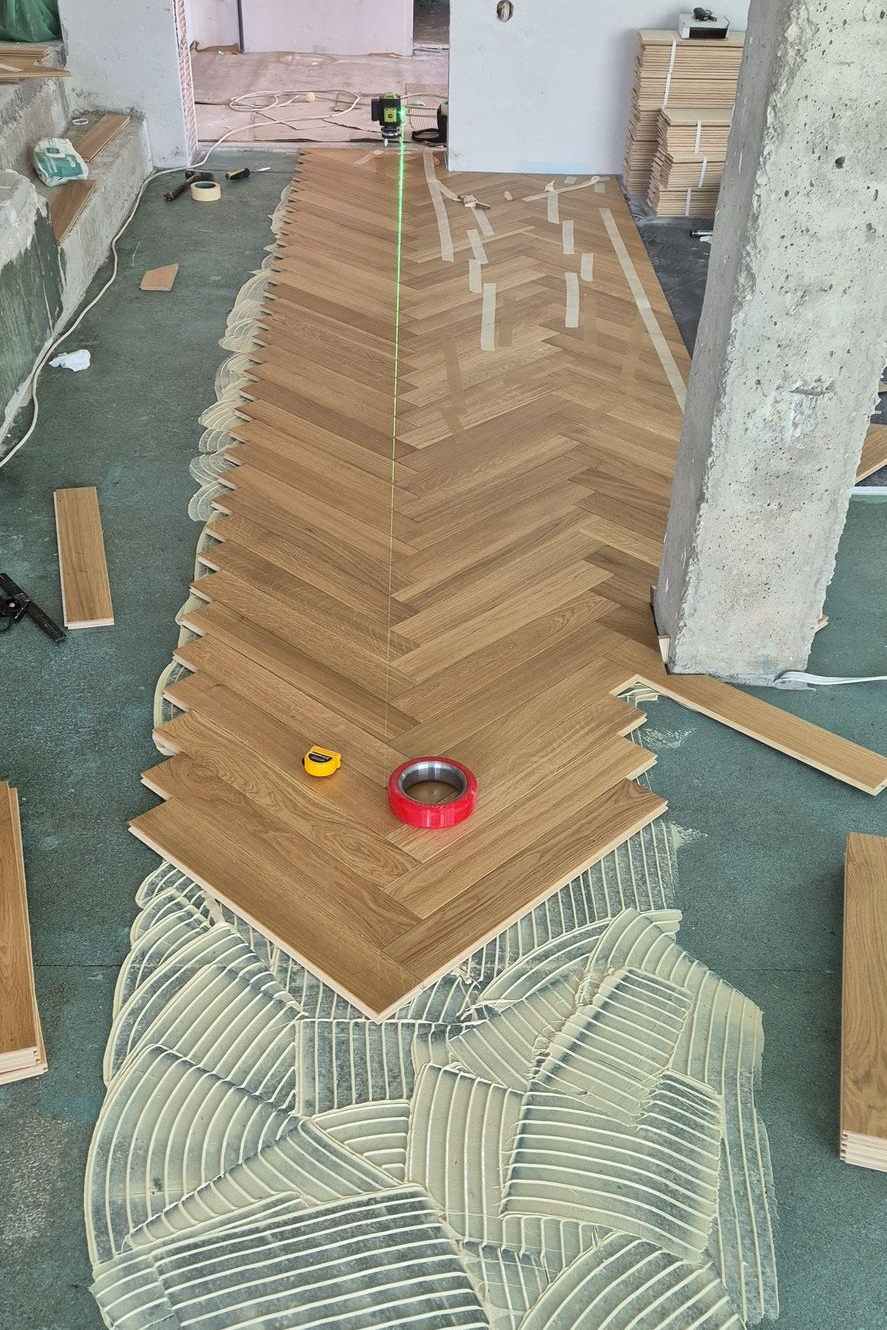
Chevron needs especially precise matching of the V-shapes. That is why both the time and the budget for installing it are usually higher than for classic herringbone — and for both patterns higher than for a straight plank. An exact quote is prepared after reviewing the specific project.
How to choose: a short guide
- You want a rhythmic classic that also works in smaller rooms — choose herringbone.
- You want clean symmetry and a room that looks longer — choose chevron.
- You have a large open space and want a strong visual presence — consider chevron, double herringbone or a bespoke composition.
- You have underfloor heating — choose an engineered construction and glued installation.
Neither pattern is better in every case — the room decides.
Herringbone and chevron — frequently asked questions
Are chevron and Hungarian point the same thing?
Yes. Hungarian point is another name for chevron — a pattern with ends cut at 45° or 60° that meet in a V-shaped line.
Are herringbone and chevron suitable for underfloor heating?
Yes — with an engineered construction, a prepared subfloor and professional glued installation.
How long does production take?
The usual lead time for made-to-order production at our base in Trud is 3–5 weeks, and up to 6 weeks for special sizes and more complex colours.
Not sure which pattern is right for you?
Send us a plan, a photo or the approximate floor area, and tell us whether there is underfloor heating. We will help you choose the pattern, the lamella size and the laying direction. You can also browse the herringbone and chevron models we offer.