
When we started out in 1998, we made solid oak flooring, three-layer parquet and different kinds of engineered oak flooring. After more than 25 years and thousands of square meters installed, we gradually narrowed our production down to a single construction. Not because it is the easiest or the cheapest to produce, but because it gives us the quality we want to stand behind over time.
In short: Artistico did not simply choose “engineered instead of three-layer” parquet. We chose a specific manufacturing specification — 4 mm of natural European oak, a multi-layer birch plywood core, a tongue-and-groove joint and full glued-down installation. It is this combination that gives us the stability, the scope for refinishing and the control we look for in our own floors.
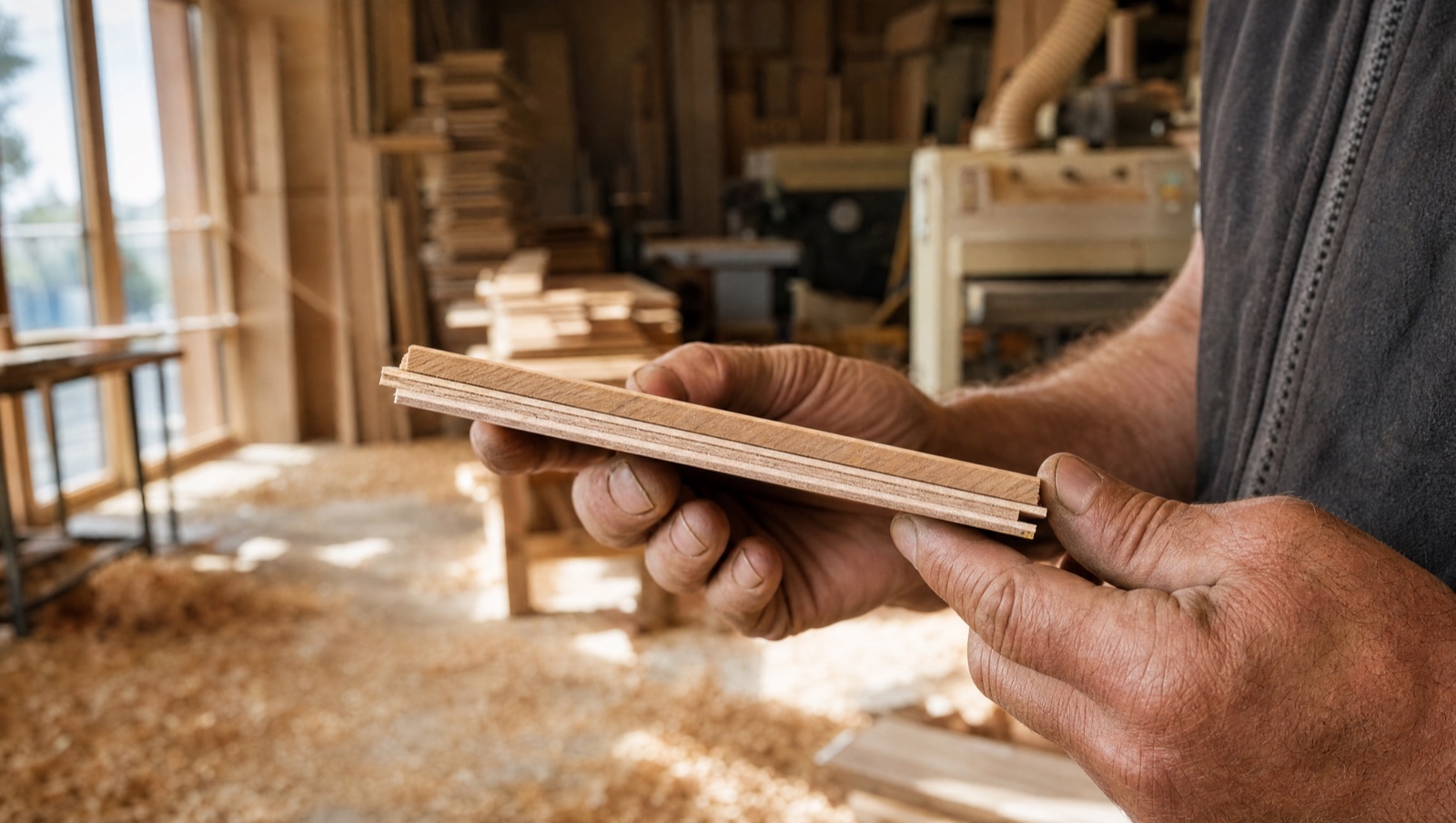
Why the construction of a parquet floor matters
For most people, choosing a floor happens once or twice in a lifetime, and it is a difficult choice. That is because the floor will be part of our daily life for decades to come.
At Artistico we know that feeling very well, and we know the weight of the responsibility we carry — to make parquet that keeps its qualities for decades and that can be restored when needed rather than replaced.
So after years of working with different types of parquet, we settled on one clearly defined engineered construction — 4 mm of natural oak over cross-bonded birch plywood. This is the solution that gives us confidence in the quality and the option to refinish the floor more than once — the qualities we look for in every floor that carries the Artistico name.
How we arrived at the construction of our engineered oak flooring
When we started work in 1998, we were a small workshop making solid oak flooring in the village of Trud near Plovdiv. At the time customers were mostly looking for solid oak, and engineered wood floors were still finding their way onto the Bulgarian market.
Over the years that followed we began producing different constructions, in order to find the best combination of stability, durability and scope for future refinishing:
- Three-layer parquet with a 2.5 mm top layer on a core of softwood lamellas — a widespread construction that is more affordable to produce.
- Engineered oak flooring with a 3 mm top layer on birch plywood — an important step toward a more stable core and greater scope for refinishing.
- Engineered oak flooring with a 4 mm top layer on cross-bonded birch plywood — the construction that gradually became our standard.
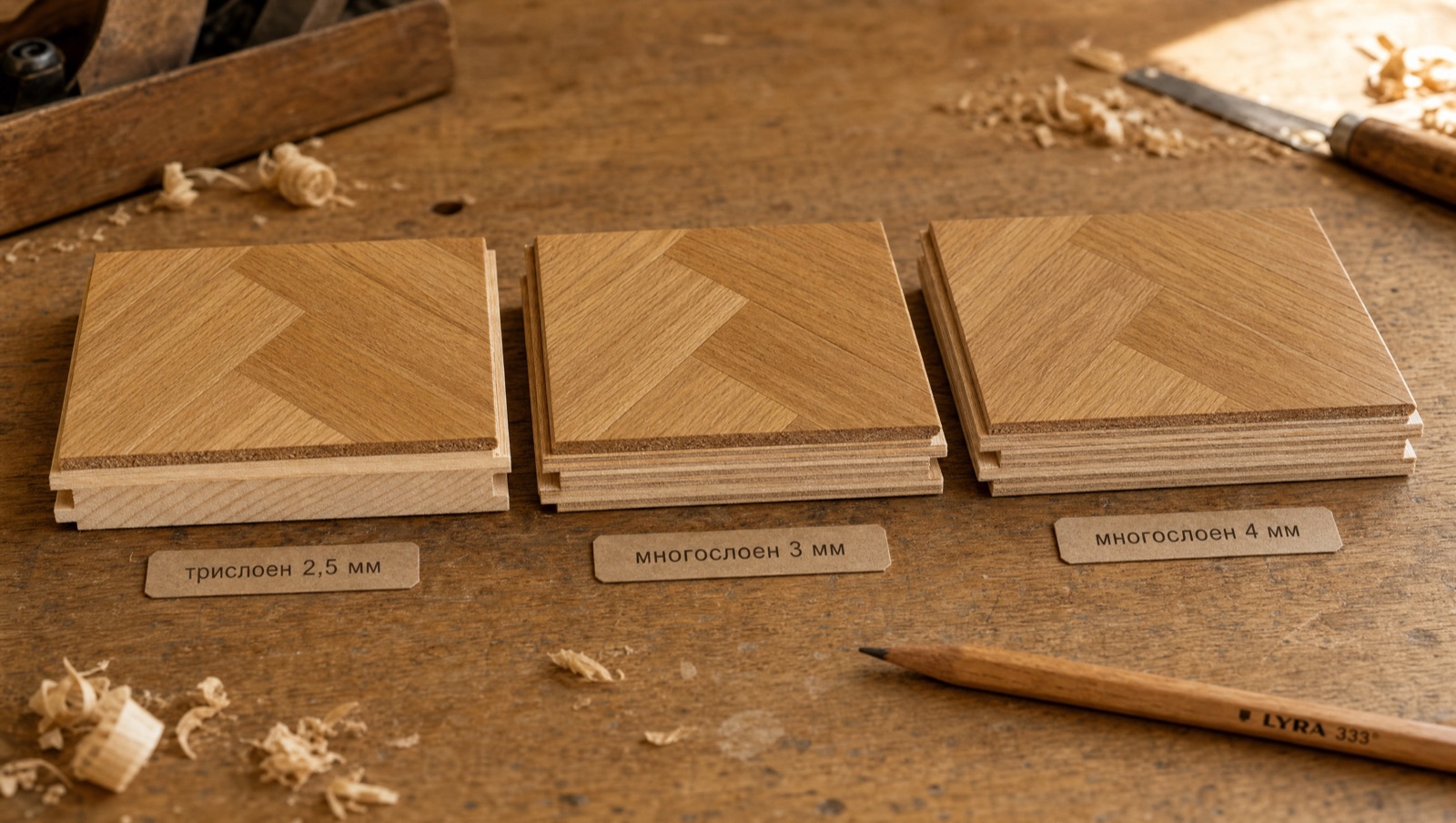
The real difference was not visible on installation day. It became clearer when we came back to those projects eight, twelve or fifteen years later to refinish the floor. With a thinner top layer the room for sanding was more limited, while the 4 mm layer left a larger reserve for restoring the surface.
It was watching real floors over time that helped us choose the construction we still use today.
Why we chose 4 mm oak, birch plywood and glued-down installation
1. A thicker top layer allows future refinishing
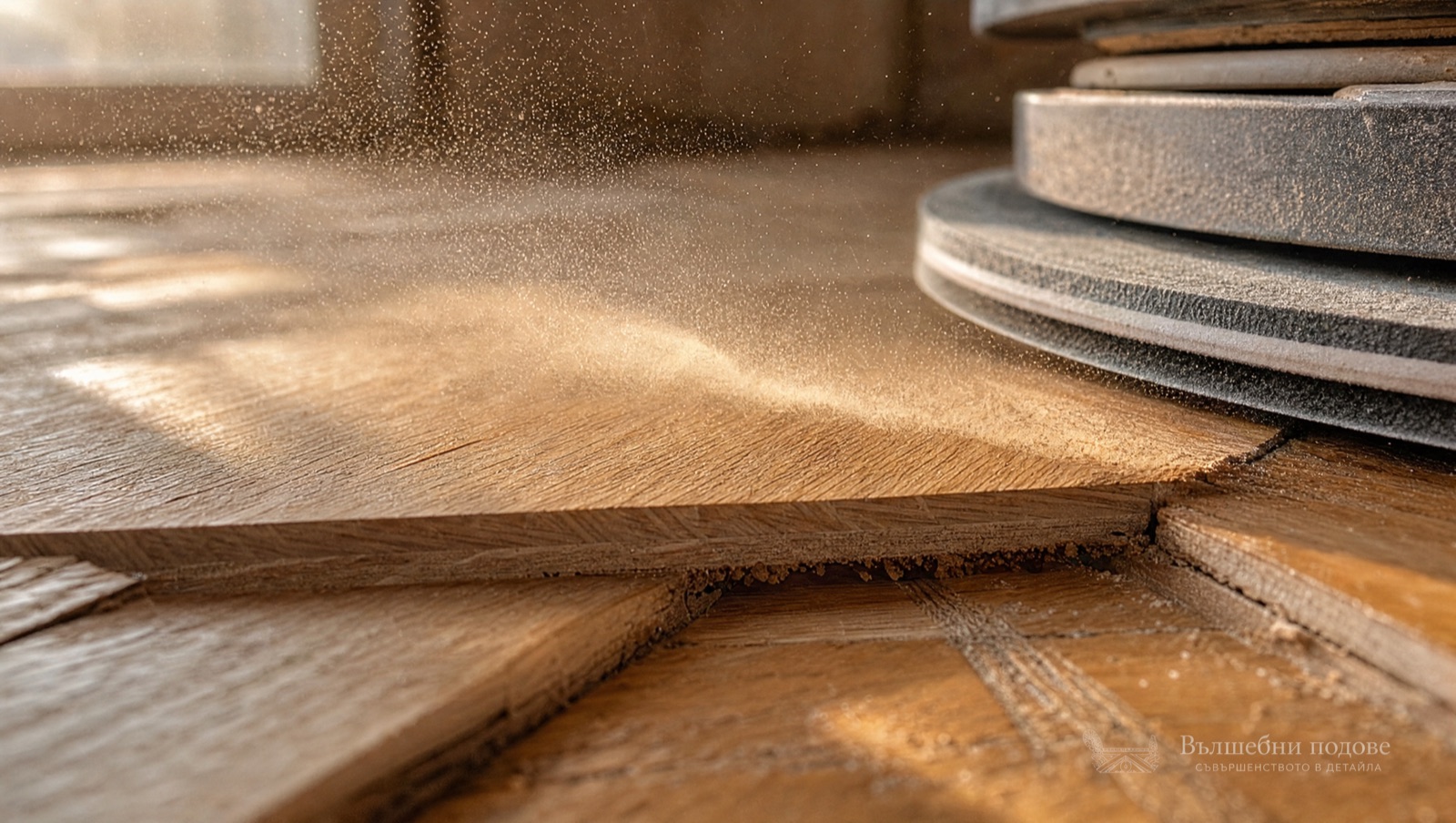
A full sanding of an oak floor usually removes about 0.5–0.8 mm of the top layer, to take out the marks of wear and prepare the surface for a new lacquer or oil. The exact amount depends on the condition of the floor and the equipment used.
Not every floor needs sanding on the same schedule. In heavily used rooms refinishing may be needed sooner, while with proper maintenance and lighter use the first full sanding can be postponed for years.
A 4 mm top layer leaves enough reserve for the floor to be thoroughly refinished more than once. The exact number of sandings is determined after a professional inspection, but the scope is considerably greater than with a floor that has a thin top layer.
For us this difference is not just a technical figure. We have seen it in real floors we returned to years after installation. When the construction has enough natural wood above the core, the surface can be restored and the floor can stay in use instead of being replaced.
2. Birch plywood limits the natural movement of the wood
Wood is a natural material and it reacts to changes in humidity and temperature. During the heating season the air indoors usually becomes drier, and in summer humidity rises. This makes the wood elements shrink and expand naturally, whatever the type of parquet.
The crosswise softwood lamellas in three-layer parquet are also there to improve its stability. In Artistico's engineered oak flooring we use a birch plywood core built from 5 to 9 thin layers, bonded crosswise to one another. That way the movement of each layer is held back by the neighboring ones, and the whole construction reacts less to seasonal changes.
This does not mean that the wooden floor becomes completely immobile. But when a stable multi-layer core is combined with a well-prepared screed, a fully glued-down installation and a suitable indoor climate, the risk of deformation, gaps opening up and unwanted noises is significantly reduced.
We see the result in real projects too. Floors we produced and installed more than 20 years ago are still in good condition when used and maintained correctly. It is these observations over time that established birch plywood as the core of the engineered oak flooring we produce today.
3. Why we glue the parquet to the subfloor
The click system is convenient and has its place. It joins the individual planks quickly and usually allows the floor to be laid floating over an underlay, without gluing it to the screed. Installation is easier and the floor can be used straight away.
With the natural wood flooring we produce, we are after a different feel. A floating floor stays separate from the subfloor and, even when it is installed correctly, it can feel softer and sound more hollow underfoot. This does not mean that this installation method is wrong — it simply is not the result we want for Artistico floors.
That is why we use a tongue-and-groove joint and glue every plank to a well-prepared screed. We work with professional two-component polyurethane adhesive systems from Wakol, Loba and Vermeister, which create a tight and lasting bond between the parquet and the subfloor.
You feel the difference when walking — the floor is more stable, quieter and moves less. With underfloor heating, the absence of an underlay also allows more direct heat transfer when the whole system is correctly executed.
Glued-down installation requires more time, more materials and very good preparation of the subfloor. For us the effort is worth it, because we do not produce the parquet separately from the installation — we take responsibility for the final result.
4. Engineered oak flooring over underfloor heating
Until a few years ago, underfloor heating was present in only some of our projects. Today it is an increasingly common requirement in new homes and one of the first questions our clients ask when choosing a natural wood floor.
Wood reacts to changes in temperature and humidity. With underfloor heating these changes repeat every time the system switches on and off, which is why the stability of the construction and correct installation are especially important.
For such projects we usually recommend Artistico engineered oak flooring with a total thickness of 16 mm — a 12 mm core of cross-bonded birch plywood and 4 mm of natural oak. Compared with our 19 mm version, the smaller total thickness allows more direct heat transfer, while the multi-layer core limits the natural movement of the wood.
A good result, however, does not depend on the flooring alone. It requires a dry and level screed, a suitable adhesive, a fully glued-down installation and a correctly set heating system. After a longer shutdown the temperature should be raised gradually, and the humidity in the room kept roughly between 40% and 60%. The surface temperature of the wooden floor should normally not exceed 27°C or the limit specified by the system manufacturer.
When all these conditions are met, engineered oak flooring and underfloor heating can work reliably together and deliver the comfort of natural wood without unnecessary risk to the floor.
What makes up the price of engineered oak flooring
The price of engineered oak flooring is not determined only by the way it looks. Behind it lie the amount of natural oak, the type of core and the way the floor will be installed.
The 4 mm top layer contains more high-quality hardwood than constructions with a thinner layer. With a 2 mm version, for example, the amount of oak used is half as much. For our floors we select European oak according to its quality, structure and grade, which also affects the production cost.
A core of cross-bonded birch plywood is more expensive than a standard core of softwood lamellas. Added to this is the fully glued-down installation — professional two-component adhesives, careful preparation of the screed and the work of a specialized team require more materials and more time on site.
We could offer a more affordable construction with a thinner top layer, a different core or a floating installation. We chose not to make that compromise with the floors that carry the Artistico name.
On installation day the difference is not always noticeable straight away. It becomes more important over the years — with seasonal changes, with use over underfloor heating and when the time comes for the parquet to be renewed. The materials and the way of working we have chosen are intended for exactly this longer perspective.
One team — from production to future maintenance
Choosing one clearly defined construction allows us to take responsibility for the whole process, not just for a single stage of it. We produce the parquet at our own facility in the village of Trud, apply the lacquer or the oil on our own UV line, organize the delivery and carry out the installation with our own specialized teams.
For the client this means one contractor and one clear point of contact — both during the project and for future maintenance. If after some years the floor needs refreshing, re-oiling or sanding, the process does not have to start over with an unfamiliar company.
We know the construction of the parquet, the materials used and the way the surface was finished. This helps us judge what maintenance is needed and how the floor can be renewed according to its condition.
Working to one main production standard lets us build experience with every new order and keep better control over quality — from the choice of the wood to the last step of the installation. It is this consistency that stands behind the floors carrying the Artistico name.
One construction logic, different floors
The principle of a stable multi-layer core runs through the different floors we make. The format, the sizes and the type of top layer change with the project, but the aim stays the same — a natural look, controlled movement of the wood and professional glued-down installation.
- Engineered oak flooring — straight planks 90 to 220 mm wide, with a total thickness of 16 or 19 mm. Suited to interiors that call for a calm look, natural oak and a sense of space.
- Herringbone and chevron — engineered parquet elements for classic and contemporary geometric layouts. We offer standard and Hungarian herringbone, double compositions and special solutions designed for the project.
- Art parquet — rosettes, figural panels and decorative friezes, made to an individual design and matched to the rest of the wooden floor.
- The Tabu Collection — a line with natural Italian Tabu veneer over a stable multi-layer core, created for more distinctive colors, textures and interior solutions.
This lets us apply the production experience we have built up across different formats — from wide plank flooring to complex art parquet. Whichever look is chosen, production, finishing and installation stay in the hands of one team, with clear responsibility for the end result.
When we would recommend a different floor
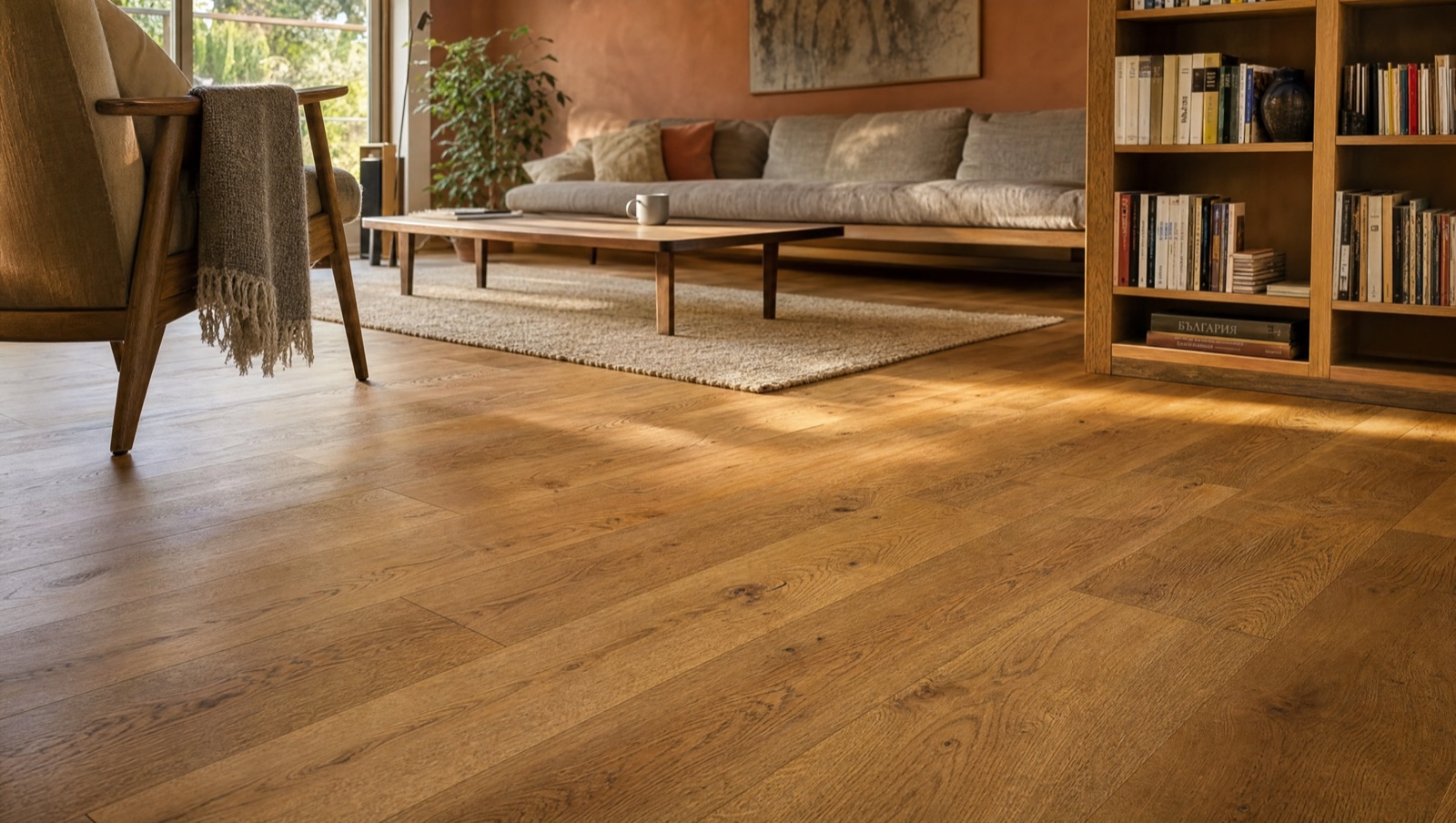
We believe in the parquet we make, but we do not think it belongs everywhere. There are projects where a more affordable or more water-resistant floor covering is simply the more sensible choice.
- If the home is temporary or is being prepared for renting out, investing in a floor built to last for decades may not be the main priority. In that case a good three-layer parquet or laminate is often perfectly sufficient.
- If a full renovation is coming up on a limited budget, it is sometimes better to choose a more affordable floor covering and spread the money across the kitchen, the bathroom or the furnishings as well. The floor matters, but it is part of the whole home.
- If the room gets wet regularly, natural wood is not the right material. For a bathroom we would recommend SPC vinyl flooring or ceramic tiles, and for an open terrace — outdoor decking or a covering made for exposure to the weather.
- If there is moisture in the screed, the cause has to be found and removed first. No parquet can hide a problem in the subfloor and still stay stable over time.
When we talk with a client, we do not start with the color and the size of the planks but with the room itself and the way it will be used. If we judge that Artistico engineered oak flooring is not right for a particular project, we will say so openly. Sometimes the soundest advice is not to buy from us — and for us that too is part of our responsibility to the client.
Let us look at your project
Whether you are furnishing a new home or updating an existing interior, you can start with a few basic details — approximate area, rooms, city, and a photo or a plan if you have one.
We will discuss which format, thickness and finish would suit your project. If needed, we will arrange a free site visit and a professional on-site survey. We will also bring real samples, so you can see how the chosen colors and surfaces look in the room and in natural light.
The consultation comes with no obligation. Our first task is to understand what your floor needs and whether Artistico engineered oak flooring is the right solution — only then do we talk about a specific quote.
Frequently asked questions
Can I order three-layer parquet from you?
We do not make three-layer parquet — it is not part of our production range. When a client is specifically looking for a three-layer construction and we are not the right fit for the project, we point them to partner stores that carry serious European brands. That is better than us making a product that does not meet our standard.
How much more expensive is engineered flooring with a 4 mm top layer than standard three-layer parquet?
Our engineered oak flooring starts at around BGN 132/m² for unfinished material. Mass-produced three-layer parquet from European brands starts at BGN 60–80/m². The difference looks large, but it covers twice as much oak, a more stable core and glued-down installation with professional 2K adhesives. Over a 20-year horizon the engineered floor works out cheaper — because it does not get replaced.
What is the difference between engineered and three-layer parquet — in detail?
We published the detailed comparison in a separate article — Engineered vs three-layer parquet — which is better for your home. There we explain the difference point by point: top layer, core, sanding, underfloor heating, installation, price, lifespan.
How long does Artistico engineered oak flooring last?
40–60 years and more, with maintenance. This is not a marketing figure — we are talking about floors we installed 20–25 years ago that are still in use and in good condition on their first or second sanding cycle. Wood is long-lived if the construction allows it.
Do you manufacture to order for non-standard projects?
Yes. Standard sizes are 90–220 mm wide and 16 or 19 mm thick. On a custom project — up to 240 mm wide. On special order with glued-down installation — up to 300 mm. The same flexibility applies to colors, oak grade (Standard / Plus / Prima) and finish type (UV lacquer, UV oil, hardwax oil, 2K water-based lacquer — all Loba systems). Lead time 3 to 6 weeks depending on complexity.